Thursday, February 10, 2011

C. ronaldo

C. ronaldo


Biodata  

Cristiano Ronaldo, Pemain Sayap Kiri Manchester United 
 BIODATA

Nama : Cristiano Ronaldo dos Santos Aveiro

Lahir : Funchal, Portugal 5 Februari 1985

Posisi : Sayap Kiri/Kanan, Foward

Klub : Manchester United

Nomor Punggung : 7

Karir :
Klub Andorinha 
Klub CD Nacional (1995) 
Klub Sporting CP, 25 games, 3 gol (1999 - 2003) 
Manchester United, 134 games, 36 gol (2003 - sekarang) 
Tim Nasional Portugal, 48 games, 19 gol (2003 - sekarang)

Penghargaan :
Liga Premier FA, Manchester United (2006 - 2007) 
Piala FA, Manchester United (2004) 
Piala Liga Sepakbola, Manchester United (2006) 
Community Shield, Manchester United (2007) 
Pemain Terbaik PFA 2007 
Pemain Muda Terbaik PFA 2007 
Pemain Favorit Terbaik PFA 2007 
Tim Terbaik PFA Premiership (2005-2006,2006-2007) 
Penghargaan dari Asosiasi Football Writers' (2007) 
Barclays Player of the Season (2006-2007) 
Barclays Player of the Month (November 2006, Desember 2006) 
PFA Fans' Player of the Month (Oktober 2006, Februari 2007) 
Pemain Terbaik Manchester United (2006-2007) 
Pemain Terbaik Sir Matt Busby (2006-2007) 
Pemain Terbaik Portugal (2007)

BIOGRAFI

Cristiano Ronaldo dos Santos Aveiro, lahir pada tanggal 5 Februari 1985 di Funchal adalah seorang pemain sepakbola berkebangsaan Portugal. Saat ini ia bemain di klub Manchester United di posisi sayap kiri. Ia memulai karir internasionalnya dengan membela tim nasional Portugal sejak tahun 2003. 

Cristiano Ronaldo mulai bermain sepakbola pada saat usianya tiga tahun. Tim favoritnya ketika masih muda adalah SL Benfica. Ia bermain untuk pertama kalinya dengan tim amatir, Andorinha, ketika usianya 8 tahun. Tahun 1995, reputasi Cristiano Ronaldo sudah berkembang di Portugal. 

Dua tim sepakbola terkenal, CS Marítimo dan CD Nacional tertarik dengan Cristiano Ronaldo. Marítimo, tim terbesar tertinggal mengadakan rapat dengan manajer Andorinha, hasilnya Ronaldo masuk ke CD Nacional. Setelah mendapatkan juara di Nacional, Ronaldo pindah ke Sporting CP.

Ronaldo memulai debut pertamanya bersama Sporting saat melawan Moreirense dan menghasilkan skor dua gol. Ia juga menjadi fitur Portugal dalam kejuaraan UEFA Under 17.

Penampilannya di kejuaraan UEFA Under 17 membawa perhatian sepakbola dunia. Yang pertama kali melihat penampilan Ronaldo adalah manajer Liverpool F.C, Gérard Houllier. Tetapi Liverpool menolaknya karena Ronaldo masih terlalu muda dan memerlukan waktu untuk berkembang menjadi pemain sepakbola yang terkenal. 

Pada tahun 2003, Ronaldo mendapat perhatian dari Sir Alex Ferguson, ketika Sporting mengalahkan Manchester United dengan skor 3-1 di inagurasi Alvalade XXI di stadium Lisbon.

Ferguson memutuskan menginginkan pemain muda untuk timnya, Ronaldo menandatangani kontrak dengan harga £12.24 juta. Debut pertamanya dengan Manchester United (MU) adalah pada saat melawan Bolton Wanderers di menit ke-60 di stadium Old Trafford dengan kemenangan MU 4-0.

Debut karir internasionalnya yaitu pada bulan Agustus 2003 saat Portugal melawan Kazakhstan. Di pembukaan Euro 2004, Portugal kalah dari Yunani dengan hasil 2-1. Pada saat semifinal melawan Belanda, Ronaldo menciptakan gol pertamanya dengan hasil akhir 2-1 kemenangan bagi Portugal. 

Ronaldo menghantarkan Portugal ke Olimpiade Musim Panas 2004, dan ia menjadi skor tertinggi nomor dua fi Kualifikasi Piala Dunia FIFA di zona Eropa dengan 7 gol. sampai tanggal 17 Juni 2005, skor Ronaldo adalah 11 gol dalam 25 pertandingan untuk Portugal.

Tuesday, January 18, 2011

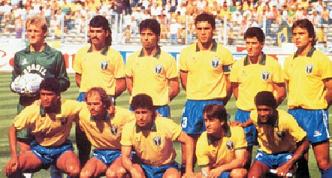
World Cup Football - Italy 1990


The 1990 FIFA World Cup was the 14th FIFA World Cup, the quadrennial international football world championship tournament. It was held from 8 June to 8 July 1990 in Italy, the second country to host the event twice. Teams representing 116 national football associations from all six populated continents entered the competition, with its qualification process beginning in April 1988. Twenty-two teams qualified from this process, along with host nation Italy and defending champion Argentina, for the finals tournament. The official match ball was the Adidas Etrusco Unico.


The tournament was won by West Germany, who claimed their third World Cup title by defeating reigning champions Argentina 1–0 in the final, a rematch of the previous final four years earlier. Hosts Italy beat England 2–1 to finish third after both lost their semi-finals in penalty shootouts.  The 1990 World Cup is widely regarded as one of the poorest World Cups ever. It generated a record low goals-per-game average of just 2.21 and a then-record 16 red cards were handed out, including the first ever dismissal in a final.


Despite the low goalscoring, the 1990 World Cup stands as one of the most watched events in television history, garnering an estimated 26.69 billion non-unique viewers, compiled over the course of the tournament.[5] At the time it was the most watched World Cup in history in non-unique viewers, but has subsequently been bettered by the 1994 and 2002 FIFA World Cups.[6]  Following this World Cup, the back-pass rule was introduced in 1992 to discourage time-wasting and overly defensive play, and wins were awarded three points in the group stage of the 1994 World Cup to encourage more aggressive offensive tactics and discourage the strategy of playing for a draw.


Host Selection


FIFA World Cup hosts  The vote to choose the hosts of the 1990 tournament was held on 29 May 1985 in Zürich, Switzerland. Here, the FIFA Executive Committee chose Italy ahead of the only rival bid, the USSR, by 11 votes to 5. This awarding made Italy only the second nation to host two World Cup tournaments, after Mexico had also achieved this with their 1986 staging. Italy had previously had the event in 1934, where they had won their first championship.  Austria, England, France, Greece, West Germany and Yugoslavia also submitted initial applications for the 31 July 1983 deadline. A month later, only England and Greece remained in the hunt with Italy and the Soviet Union after the other contenders all withdrew. All four bids were assessed by FIFA in late 1983, with the final decision overrunning into 1984 due to the volume of paperwork involved. In early 1984, England and Greece also withdrew, leading to a two-horse race in the final vote. The Soviet boycott of the 1984 Olympic Games announced on the eve of the World Cup decision was speculated to have been a major factor behind Italy winning the vote so decisively, although this was dismissed by FIFA President João Havelange.


Qualification


116 teams entered the 1990 World Cup, with 114 being required to qualify (due to rejected entries and withdrawals, 103 teams eventually participated in the qualifying stages). Italy as host nation and Argentina as reigning World Cup champions were granted automatic qualification, with the remaining 22 finals places divided among the continental confederations.  Thirteen places were contested by UEFA teams (Europe), three by CONMEBOL teams (South America), two by CAF teams (Africa), two by AFC teams (Asia), and two by CONCACAF teams (North and Central America and Caribbean). The remaining place was decided by a play-off between CONMEBOL and OFC (Oceania).  Both Mexico and Chile were disqualified during the qualification process; the former for fielding an overage player in a prior youth tournament, the latter after goalkeeper Roberto Rojas faked injury from a firework thrown from the stands, which caused the match to be abandoned. Chile were also banned from the 1994 qualifiers for this offence.  Three teams qualified for the first time: Costa Rica, the Republic of Ireland and the United Arab Emirates.  Returning after long absences were Egypt, who qualified for the first time since 1934; the United States, who competed for the first time since 1950, Colombia who appeared for the first time since 1962; and Romania, who last appeared at the Finals in 1970.  Among the teams who failed to qualify were Hungary, France, Poland, and Portugal.


The Final


The final between West Germany and Argentina has been cited as the most cynical and lowest quality of all World Cup Finals. In the 65th minute, Argentina's Pedro Monzon was sent off for a foul on Jürgen Klinsmann, the first player ever to be sent off in a World Cup Final.  Argentina, weakened by suspension and injury, offered little attacking threat throughout a contest dominated by the West Germans, who struggled to create many clear goalscoring opportunities. The only goal of the contest arrived in the 85th minute when Mexican referee Edgardo Codesal awarded a penalty to West Germany, after a foul on Rudi Völler by Roberto Sensini. Andreas Brehme, who later said there was no foul, converted the spot kick to settle the contest. In the closing moments, Argentina were reduced to nine after Gustavo Dezotti received the second red card of the game when he hauled Jürgen Kohler to the ground during a stoppage in play. The 1–0 scoreline provided another first: Argentina were the first team to fail to score in a World Cup Final.  With its third title (and three second place finishes) West Germany – in its final tournament before national reunification – became the most successful World Cup nation, until Brazil won their fourth title in 1994. West German manager Franz Beckenbauer became the only man to both captain (in 1974) and manage a World Cup winning team, and only the second man (after Mário Zagallo of Brazil) to win the World Cup as a player and as team manager. It was also the first time a team from UEFA won the final against a non-European team.


Results


Monday, January 17, 2011

Global warming is our common problems

Global warming is our common problems. This can not go unpunished. Increasing the temperature of the earth and climate change has become evidence of global warming. Clearly, global warming is a clear and present danger. The principle of common but differentiated responsibility, the cornerstone of the Kyoto Protocol, reflects historical reality. However, implementing the principle is near impossible in a world defined by states, which militate against a sense of global responsibility.

In 2010 actually confirms global warming because it was the 34th consecutive year with temperatures above the 20th century global average. One effect is the diminishing of the Arctic sea ice cover. It is at its third smallest since records began in 1979. Another effect is freak weather conditions across the globe. The earth's temperature was higher by 0.62 degrees Celsius on the 20th century average making 2010, along with 2005, the hottest years since US records began in 1880. Last year was also the warmest in India since our records began in 1901. via

Monday, January 3, 2011

Recent facts about Global Warming in Spanish

Global warming still a hot issue for discussion. Recently, Spanish has a lot of facts about global warming. Southern Alliance for Clean Energy is now releasing Spanish versions of our newly created, state specific, global warming fact sheets. Through these translated materials, SACE is continuing its effort to educate the Latino community on the current and future impacts of global warming in the Southeast and the United States as a whole.

For far too long, Hispanics have been marginalized in the political process due to simple language barriers; an astounding fact given that over 15% of our country self-identifies as being of this ethnicity.

Global warming will affect everyone, yet studies show that it will affect some more than others. For example, there are nearly 4 million Hispanics in the state of Florida, comprising almost a quarter of the population.

Furthermore, Hispanics in the state earn on average $7,000 less a year than the average non-Hispanic white person. This disparity in income is important because a recent Oxfam America report highlighted that race and economic status play a key role in how much a person will be impacted by global warming.

The only way we can protect Latinos living in vulnerable areas is through education and encouraging increased participation to demand strong state and federal climate and energy policies from their legislators. via

Sunday, December 26, 2010

Global Warming on Bulgaria on Christmas Day

Global warming is increasing. The previous record on Christmas Day in Veliko Tarnovo was recorded in 1956, long before the more recent effects of the global warming started to kick in, and it was only 16.6 degrees Celsius.

There is good reason to reflect for a moment about global warming. Weather forecasts predict that as of Monday, all of Bulgaria will experience much lower temperatures with the still typical winter weather setting in by the end of next week.

Instead of the traditional snowy Christmas, several Bulgarian cities had temperature records on December 25, 2010, Christmas Day. The highest air temperature in Bulgaria on Saturday was recorded in the northern city of Veliko Tarnovo – 20.1 degrees Celsius. via

Tuesday, December 21, 2010

Kajol: An Indian Women on Cinema Screen


Kajol is the woman who has represented Indian women on the Bollywood Cinema. The class of young as well as traditional women find immediate identity with the roles she plays.
Kajol

She had acted in many films playing almost similar roles of a loving girl or a responsible but humorous woman.

Life of Kajol

Born to a family with mother being an actress and father being a film producer, Kajol had the films in her veins. Her mother Tanuja was a wonderful actress of Indian cinema in late 1960s and 1970s. Her husband, Ajay Devgan, is also a well-known actor in the Indian cinema.

Kajol's Film Career

Except couple of years in the beginning of her carer, Perhaps Kajol was not required to struggle for getting a good roles in the films. She had always good offer from renowned film directors.

Kajol had started ruling the Indian screen after the great success of the film Dilwale Dulhaniya Le Jayenge. She had paired wonderfully with the equally talented hero, Sharukh Khan in many films. Their films like Kabhi Khusi Kabhi Gam and the latest 'My Name is Khan' are some of the best examples of their good chemistry on the screen.

In most of her roles on screen, Kajol has posed as possessing the values Indian society regards very high. In the films she had acted during the last decades, she had mostly acted as mother of a child and a major character in the family involved in the story of the film. She would not miss to spread the showers of humorous phrases on the screen. This has made her as much acceptable among the traditional and the young audience, too. [[Image courtesy By By Gochaaa18 (Own work) [CC0], via Wikimedia Commons Wikimedia Commons ]]

Monday, December 20, 2010

Sophie Marceau : Beauty of France

There are very few people who belongs to very low strata of income and become a good film star. If a woman is daughter of a woman who is working in a shop and the father who is a truck driver, this becomes the major hurdles for making a career in the glittering world of the cinema. But Sophie Marceau, an actress of France did it.

Sophie Marceau

Born in November 17, 1966, Sophie Marceau was a Parisian by birth. She started her career as a child artist. In addition to being a prolific actress, she had a sweet and cultivated voice. Sophie had used her voice in films, too. Her work as child artist, teenager actress and as a major role in films were praised around the world.

Her novel Telling lies was published in 2001. she had written the novel and that is beloved to be her semi autobiographic record of her life and her career.

Sophi is a widely and critically acclaimed person in the film industry of France. She was selected for a prestigious Award "Cesar for Best Feminine Hope" for her wonderfully played role in "La Boum 2". She had received this award in the year 1983. Sophie has to wait for her international success. But she continued beautifying the French screen. Ultimately the time came when she had a film with Mel Gibson in the year 1995. In Mel's Brave Heart, Sophie played a marvelous role of Prince Isabelle.

Sensual looking skin and a smile on lips: these twin aspects are the assets essential for the actors, especially for an actress who would be doing role full of glamour. This could facilitate to cast her in any glamorous role. Sophie Marceau has this twin assets in well pasted on her beautiful figure. In addition, she owns a sparkling pair of the French eyes. all of these factors has played their roles in making her such a popular actor in France and all around the world. [Image courtesy Georges Biard [CC-BY-SA-3.0], via Wikimedia Commons]